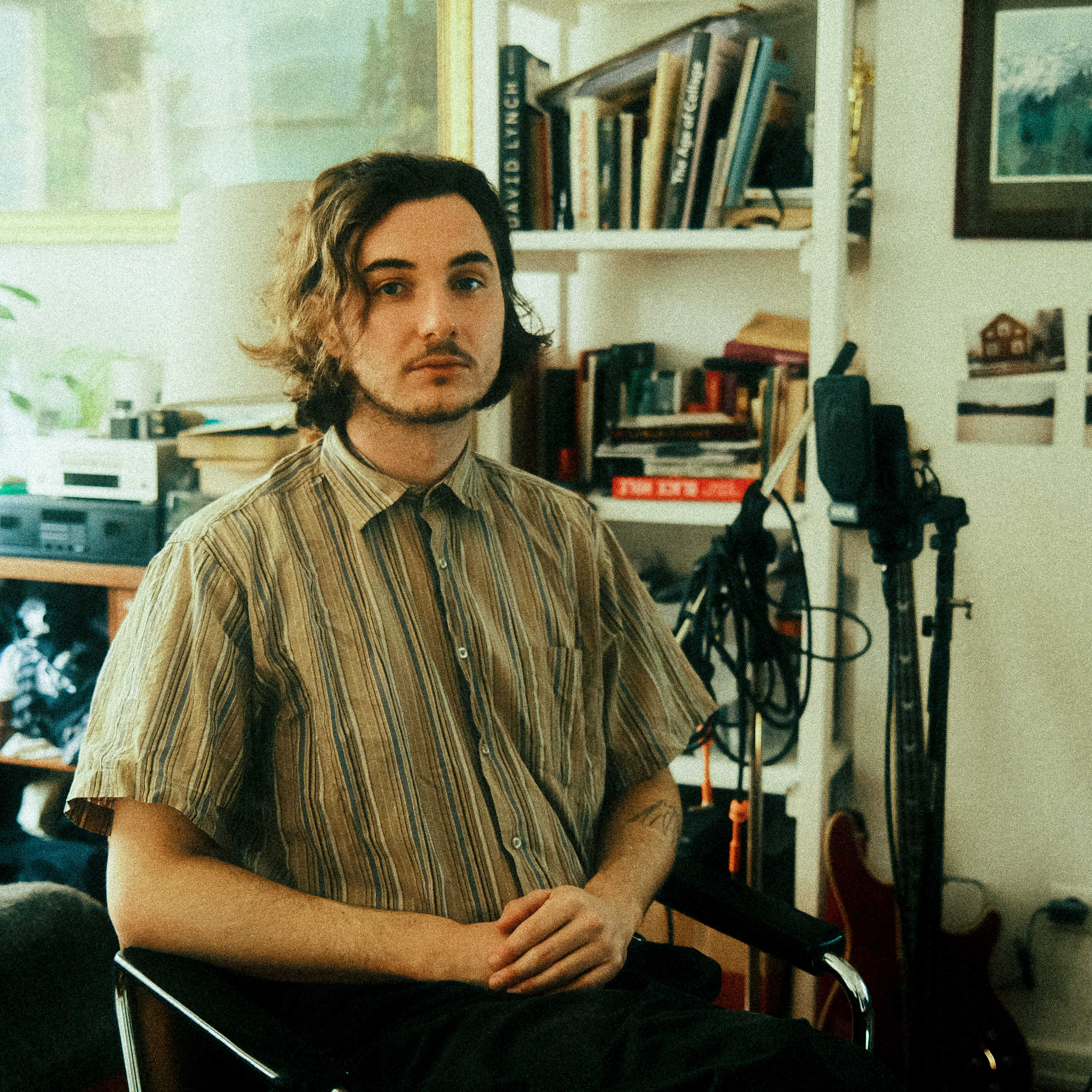
Elkks talking about "Two Points on a Map"
Tell me about your new album.
It’s called ‘Two Points on a Map’ and is the second one I’ve released as ‘elkks’ so far. I’m very happy about it, it sounds very different to ‘dawn heart dawn’ and I feel like I discovered a lot of new horizons with it. Also, I feel like it’s closer to what I want to do, closer to the essence of what ‘elkks’ is supposed to be.
Well, what IS elkks supposed to be?
‘elkks’ should mirror the way I feel. I want it to sound human, with all its mistakes. That’s very important to me. I want it to be as real as possible, to get as close as possible to my inner life.
Why does your new album sound like it does? What changed in your way of producing?
It is way more analogue this time. I went out and recorded a lot of instruments, I used no midi and didn’t use a lot of fancy effects, like I did on the album before. It is very raw.
What kind of instruments did you record?
I recorded a piano and an air organ that my grandma has in her house. I also bought a cheap banjo. But mostly I used different acoustic guitars.
Where did all the black metal and auto-tune voices go, that were ever-present on dawn heart dawn?
As I mentioned, I am always trying to find ways to express what I feel on the inside, some kind of abstract picture that my emotions form and which is always very clear to me. This time it just didn’t feel like dark forests and small cabins in the woods, so the sounds I associate with those pictures weren’t involved. I felt more silent on the inside, more clear and austere. So that is what I wanted it to sound like. Also it always depends on what I listen to at that particular moment. This album feels way more sincere than “dawn heart dawn” - I felt naked making it, like I didn’t hide behind filters and effects like I might have before. I feel more vulnerable about it, which is a good thing.
You have been making music for a while now and released quite a lot. What are the biggest challenges and difficulties for you when it comes to making an album?
Definitely just finishing it. Because at some point the original feeling that motivates you to start recording will vanish or change in some way. I made this record while I felt truly horrible about everything in life, I was grieving. So I just jumped into it and spent days and sleepless nights recording and mixing. I wanted to capture this certain feeling as fast as possible without it getting watered down.
Also I worked with some good friends of mine on it, like Nicolai Schoof, who played the drums on the record and Gloria de Oliveira, who sings on a couple of songs, and it is harder to keep the tension when you work with other people because there’s logistical stuff that interferes. But I managed to keep this tension until the end and it paid off.
What were happy accidents / serendipities while recording/mixing?
I think the happiest accident is always my singing. I know I am not a good singer, I hardly hit the notes, but sometimes that’s exactly what I need or want for a song. I’m a big fan of imperfection.
Speaking of imperfection, your records are always very lo-fi, sometimes badly recorded, a lot of time the pacing fluctuates. But it all sounds very lively and human. A lot of music today is very smooth and well recorded, beats are quantised and songs are very cleaned up in general. Why do you use this raw style of producing?
I am a big fan of naive landscape art - I want to produce music like I imagine those are painted. Lo-Fi, naivety and imperfection are important parts of my music. They’re not a side-product but the essence of it. I feel like overproducing always kills the truthfulness of the work. In a lot of my songs you can hear the sound of the metronome, but I really don’t mind that. It’s part of my music. In the raw character of my art lies the true nature of myself. I generally like art where you can feel the humanity behind it. AI is a big thing right now - personally, I feel the need to walk in the opposite direction in order to tell something that is interesting. That’s why I am very interested in the sound of early black metal, because I feel like the true form of it doesn’t lie inside the music per se, but the texture of the recordings, the grain and the noise. It creates the pictures that you can see in your mind’s eye, nature, trees, waters and wind.
When I record the instruments or sing I don’t always use the take that is technically the best or the cleanest, but the one that feels the most natural and honest. Sometimes it’s the one that’s kind of badly played. To me it feels necessary to make myself more vulnerable through these kinds of things, vulnerability is always the right direction when you make art, in my opinion.
You also work as a screenwriter and studied film. Your works are very scenic and work with a lot of pictures and certain aesthetics. Why are visuals so important to you? Do you separate your film work and your music?
When it comes to films I am very interested in the current state of society and (sub)culture.
I feel like this is somehow connected to my approach to music because it also is about the reality of things, which isn’t always neat and beautiful but can be depressing or/and rough. I feel like over-stylizing and smoothing things out is just a sort of escapism, both in film and music, generally in arts and culture. Everything has to be capitalisable - love, your body, your art. It isn’t supposed to hurt or irritate anyone, because then people won’t buy it. I really like to look for edges, to always be a little off, so you listen more carefully.
When it comes to lyrics I used to tell abstract stories that somehow carry inside what I felt, but for the new album this wasn’t the right approach. This album is about loss and grieving almost driving you insane, and it felt wrong to turn these feelings into a fake narrative. It is always easy to do that, to turn yourself and your suffering into a story or narrative that makes things have rhyme & reason. So I started to just write down what I thought and what I went through, without a lot of symbolism. Sometimes suffering has no reason or goal. It’s just there and it won’t go away for a long while.
Can you tell us about the song titles and the cover art?
The titles are small memory pieces close to my heart. A lot of them have to do with cinema, like Hedgehog In The Fog, which is a soviet animation for children, Le Rayon vert is a film by Eric Rohmer, and Werner Herzog of course refers to the director. Grandma Moses was an American folk artist known for her rural landscapes. I just like to look at her paintings. A lot of the references are perhaps only decipherable by me or two or three other people, but it doesn’t matter. In the end, you can just enjoy the sound of the words.
The cover art was made by Burcu Yildiz, an amazing illustrator. I feel like she perfectly captured the raw and naive approach of the music, reflecting a lot of the themes of the music.
How should people listen to the album?
When feeling fragile and porous, or on a long walk through nature.